Thursday, November 27, 2008
Anne says:
A comedy must be taken very seriously, much as a tragedy must be approached with great lightness and humor.


Monday, October 6, 2008
I love that show, just not the shitty Broadway version...
Yesterday on a recruiting trip to the University of Michigan, I outed myself to a coworker. "Yes," I told her, "I'd like to eventually direct professionally."
She had no idea, but they rarely do even though the signs were all there from the very beginning. Chief among the telltale signs is my skepticism of quality on Broadway. After she mentioned to me that she saw and loved, loved, loved Mama Mia, I could not stop myself.
Kristen, I just think musicals like that are a waste of my time.
to which the response is:
But they're so much fun! How can that be such a waste of time?
...and then I have to get into the shit. On the bright side, I've become much better at explaining my perspective on theater. Hopefully that will continue to clarify. A byproduct of these conversations is a list of musicals about which I can not only say "I know exactly why these people are signing" but that it moved me. In yesterday's conversation with Kristen, the ones which came out included Cabaret and Chicago - both of which I find brilliantly structured.
I also brought up Spring Awakening. After seeing the Broadway production, originally produced by the Atlantic Theater Company, I had mixed feelings. I appreciated that the musical took a risk and did something generally new to Broadway. While the lyrics were mostly incomprehensible, and the structure made no sense given the added "finale," I liked the teen sex, they gays on stage and the catchy tunes.
Then Hannah, who was my theater buddy that night, mentioned that the sex scene written by Wedekind was supposed to be full on rape. My heart sank. Chickens. I understand: hockey moms and Joe-6-Packs out there would be scandalized by any full on rape regardless of the context...but isn't that a good thing? Why should a director/adapter have to protect the audience from confronting significant questions brought up by the play? There are multiple answers here, but my guess is that the majority of it lies in Broadway economics.
I went back and read the play. It's hilarious, both despite and because of scenes like Melchior's beating Wendla, or his raping her later on. In my opinion, Wedekind doesn't want you to take anything he wrote seriously. Jonathan Franzen, the translator to my edition, mentions in the preface that there is no intelligible way to judge Wedekind's characters other than through the aesthetic and the comic. To that end, Franzen points out that there is no standard of "cosmic justice" - exemplified by the fact that rapist Melchior remains intact and lovable quirky characters like Wendla and Moritz end up destroyed. Instead, the action of the play is through and through casual and amoral.
But that makes it funny. In not committing to the original intent, turning the rape consensual, making Wendla's beating completely unfunny. Franzen mentions all of this in his preface. Surprisingly, though, he leaves out how the musical destroys the homosensual moment between Hansy and Ernst by making Hansy a predator and Ernst other an unsuspecting but willing victim.
In retrospect, I can't decide if the Broadway adaptation of Spring Awakening was on the whole more damaging in its deadliness than a run of the mill feel good musical like Mama Mia. At least with a show that saccharine, you don't expect to be moved by anything substantive. With Spring Awakening, the audience is tricked into thinking it is seeing something substantive and honest when in it's really just a bunch of florescent installed around a heavy handed canned dosage of stereotypical teen angst.
So many missed opportunities...
She had no idea, but they rarely do even though the signs were all there from the very beginning. Chief among the telltale signs is my skepticism of quality on Broadway. After she mentioned to me that she saw and loved, loved, loved Mama Mia, I could not stop myself.
Kristen, I just think musicals like that are a waste of my time.
to which the response is:
But they're so much fun! How can that be such a waste of time?
...and then I have to get into the shit. On the bright side, I've become much better at explaining my perspective on theater. Hopefully that will continue to clarify. A byproduct of these conversations is a list of musicals about which I can not only say "I know exactly why these people are signing" but that it moved me. In yesterday's conversation with Kristen, the ones which came out included Cabaret and Chicago - both of which I find brilliantly structured.
I also brought up Spring Awakening. After seeing the Broadway production, originally produced by the Atlantic Theater Company, I had mixed feelings. I appreciated that the musical took a risk and did something generally new to Broadway. While the lyrics were mostly incomprehensible, and the structure made no sense given the added "finale," I liked the teen sex, they gays on stage and the catchy tunes.
Then Hannah, who was my theater buddy that night, mentioned that the sex scene written by Wedekind was supposed to be full on rape. My heart sank. Chickens. I understand: hockey moms and Joe-6-Packs out there would be scandalized by any full on rape regardless of the context...but isn't that a good thing? Why should a director/adapter have to protect the audience from confronting significant questions brought up by the play? There are multiple answers here, but my guess is that the majority of it lies in Broadway economics.
I went back and read the play. It's hilarious, both despite and because of scenes like Melchior's beating Wendla, or his raping her later on. In my opinion, Wedekind doesn't want you to take anything he wrote seriously. Jonathan Franzen, the translator to my edition, mentions in the preface that there is no intelligible way to judge Wedekind's characters other than through the aesthetic and the comic. To that end, Franzen points out that there is no standard of "cosmic justice" - exemplified by the fact that rapist Melchior remains intact and lovable quirky characters like Wendla and Moritz end up destroyed. Instead, the action of the play is through and through casual and amoral.
But that makes it funny. In not committing to the original intent, turning the rape consensual, making Wendla's beating completely unfunny. Franzen mentions all of this in his preface. Surprisingly, though, he leaves out how the musical destroys the homosensual moment between Hansy and Ernst by making Hansy a predator and Ernst other an unsuspecting but willing victim.
In retrospect, I can't decide if the Broadway adaptation of Spring Awakening was on the whole more damaging in its deadliness than a run of the mill feel good musical like Mama Mia. At least with a show that saccharine, you don't expect to be moved by anything substantive. With Spring Awakening, the audience is tricked into thinking it is seeing something substantive and honest when in it's really just a bunch of florescent installed around a heavy handed canned dosage of stereotypical teen angst.
So many missed opportunities...
Tuesday, August 5, 2008
Preview
What are bad plays or plays you can pick up at Books & Books in Miami Beach?
- The Vertical Hour and plays with a lot of words
- A Number and why cloning will never be interesting
This week.
**AND. Caveat: Don't read too much into what Wikipedia says these plays are about...
August: Osage County, Last weekend on BwAy
August. Well. It was a solid piece of Contemporary American Theater about Contemporary America. This may be a completely unwarranted claim, but it seems to me that this particular subject area is lacking in lasting content. Sure there are some good plays, but how long will they remain relevant? In the age of Bushisms, Terrorisms and the like, how often do we see something evocative that is both contemporary and timeless?*
Of course the geographic location, syntax and social niceties implicit in the text lend itself to a time/place setting. In that way, the action in The Glass Menagerie will never escape turn of the century St. Louis. That's true, but in both cases a good production of the play make it clear that each play, at its core, is about the nature of a particular protagonist (or group protagonist for SG) in relation to their family.
 August is long, but it's worth it. Over the course of the three acts it becomes clear that Barbara, the oldest daughter, portrayed brilliantly by Amy Morton, is doing everything in her power to put things in order and under control. Theater wouldn't be theater without an obstacle, and Tracy Letts delivers. Order in the face of a suicide/murder? inspired family reunion ripe with alcoholism, incest, and more makes for a pretty interesting set of questions posed to the audience.
 On top of it all, the most poignant relationship lies between Barbara and Beverly, her mother. I was waiting patiently for the inevitable moment where they were compared, and i was not disappointed. After Beverly, in Barbara's presence manages to completely crush Barbara's younger sister Ivy, Ivy lashes out at Barb. Barbara follows her and yells "Mom told you, it wasn't me!" with the predictably inevitable but non the less stinging response being "There's no difference."
I think the success of August lies in the fact that despite being clear, it makes no effort to beat you over the head. Certain choices could have probably been improved upon BUT the team stuck to their guns and followed through. Definitely commendable. To that degree there's not toooo much to find fault with. It didn't help that Ivy, supposedly in her mid 40's looked like she was 25... but what can you do! Very good/detailed work on scenic and lighting fronts. One comment with respect to sound on behalf of my companion who said something along the lines of: "when will sound designers stop using that falling axe sound? I mean, when you have an abstract soundtrack...it doesn't seem too necessary"
Agreed. And, I have a LOT of respect for directors who can get the final moments of the play perfect. I think the last one that comes to mind in my experience (of productions I have not been a part of) is when I saw The Metamorphoses at the Circle in the Square Theater way back when. This was almost better.
To close, I'm excited by the possibility of timeless American theater about contemporary America...especially since it's hard for me to come to terms with the fact that there is a contemporary America beyond the political and The Music Television. Plays like this, ones which force us to confront our own interpersonal relationships, affirms that theater is in fact doing positive work with respect to our country's soul.
----
*In this case, by timeless I mean that dating the play has little impact on the effectiveness of its content.
Of course the geographic location, syntax and social niceties implicit in the text lend itself to a time/place setting. In that way, the action in The Glass Menagerie will never escape turn of the century St. Louis. That's true, but in both cases a good production of the play make it clear that each play, at its core, is about the nature of a particular protagonist (or group protagonist for SG) in relation to their family.
August is long, but it's worth it. Over the course of the three acts it becomes clear that Barbara, the oldest daughter, portrayed brilliantly by Amy Morton, is doing everything in her power to put things in order and under control. Theater wouldn't be theater without an obstacle, and Tracy Letts delivers. Order in the face of a suicide/murder? inspired family reunion ripe with alcoholism, incest, and more makes for a pretty interesting set of questions posed to the audience.On top of it all, the most poignant relationship lies between Barbara and Beverly, her mother. I was waiting patiently for the inevitable moment where they were compared, and i was not disappointed. After Beverly, in Barbara's presence manages to completely crush Barbara's younger sister Ivy, Ivy lashes out at Barb. Barbara follows her and yells "Mom told you, it wasn't me!" with the predictably inevitable but non the less stinging response being "There's no difference."I think the success of August lies in the fact that despite being clear, it makes no effort to beat you over the head. Certain choices could have probably been improved upon BUT the team stuck to their guns and followed through. Definitely commendable. To that degree there's not toooo much to find fault with. It didn't help that Ivy, supposedly in her mid 40's looked like she was 25... but what can you do! Very good/detailed work on scenic and lighting fronts. One comment with respect to sound on behalf of my companion who said something along the lines of: "when will sound designers stop using that falling axe sound? I mean, when you have an abstract soundtrack...it doesn't seem too necessary"
Agreed. And, I have a LOT of respect for directors who can get the final moments of the play perfect. I think the last one that comes to mind in my experience (of productions I have not been a part of) is when I saw The Metamorphoses at the Circle in the Square Theater way back when. This was almost better.
To close, I'm excited by the possibility of timeless American theater about contemporary America...especially since it's hard for me to come to terms with the fact that there is a contemporary America beyond the political and The Music Television. Plays like this, ones which force us to confront our own interpersonal relationships, affirms that theater is in fact doing positive work with respect to our country's soul.
----
*In this case, by timeless I mean that dating the play has little impact on the effectiveness of its content.
Monday, July 7, 2008
Die Soldaten, 7/3/08 @ The Armory in NYC
Die Soldaten, an opera by Bernd Zimmerman
Directed by David Pountney
Conducted by (family friend) Steven Sloane
So those of you who know me are well aware of the fact that I'm partial to German proto-expressionism-sturm-und-drang-ness. Any attempt I've ever made to explain why really goes back to the first time I saw Georg Büchner's Woyzeck performed. Here's a german news program on the production i saw at BAM's Next Wave festivl in 2002:
OK So what the fuck does this have to do with Die Soldaten? It rocked my world. It rocked. My. World. Along with Top Girls (the Chicago experience) and Woyzeck (both the Danish Tom Waits Musical production at BAM and my own), Die Soldaten - this production of Die Soldaten, will stay with me.
Briefly, the opera is based on a play by Jakob Michael Reinhold Lenz called...Die Soldaten (or, The Soldiers) and was composed by Bernd Alois Zimmerman in the vein of Schoenberg and Berg. Yes, for those of you with some exposure to classical music, you've probably already figured that it was composed in the 12-tone technique. That means that instead of pretty pretty arias, the music is quite harsh. Normally, I'm not a fan. But, it was extremely effective in matching the momentum and gravity of the action on stage.

The play is about an innocent middle-class girl, named Marie (typical, no?) who is seduced by a soldier away from her fiancé. She chooses to go with the soldier because he is higher in social status than her current man, Stoltzius. After trading up, earning a pretty gift box with a new pair of shoes, she is betrayed. What follows is her descent into the equivalent of prostitution, sleeping with soldiers effectively in exchange for their gifts. In the end, she flees the city in order to escape what she's become. annnnnnnd as you can imagine, that doesn't work so well. but more on that later.
The strength of this production manifested itself in two distinct places, though they were obviously interrelated. The first was the design. Lights, Sound, Costumes, Amazing. Scenic, though, OUT OF THIS WORLD. The opera took place in the Drill Hall in the 66th Street Armory on Park and 5th avenue. The drill hall is the size of a football field with a vaulted cieling remeniscent of a European train station, and the narrow stage stretches down the center of it, straddled by a proscenium-ish raked riser bank. The risers...are on tracks. Yes, the risers are built to move along the length of the hall, bringing the audience closer or farther to the action as necessary. One big fuck-you to pedestrian theater, this is.
More than anything, the production stood out to me as a fantastic piece of theater. The character and detail of...all...yes, all the directorial choices are the second extremely impressive component of Die Soldaten. I would like to recount the climax of the play, which occurs when Marie flees town. Live blog time:

And that wasn't even the ending. Oh boy. The crazy shit was it all made SO MUCH SENSE. SO MUCH SENSE. Wow. Ok. go to the NYTimes article to read more. I've had a theatergasm and I'm speechless.
Amazing.
Directed by David Pountney
Conducted by (family friend) Steven Sloane
So those of you who know me are well aware of the fact that I'm partial to German proto-expressionism-sturm-und-drang-ness. Any attempt I've ever made to explain why really goes back to the first time I saw Georg Büchner's Woyzeck performed. Here's a german news program on the production i saw at BAM's Next Wave festivl in 2002:
Anyway, the bottom line for me was that I knew I had seen something amazing when I was still talking about it a week later. It was dissonant, disturbing, jaw dropping, epic, stylistic, transformative, and i still vividly remember it 6+ years later. A lot of it, obviously, was due to the production. Caveat: There are plenty plenty PLENTY bad Woyzecks out there...but for the sake of this blog lets just assume i'm talking about the play in terms of it's potential.
OK So what the fuck does this have to do with Die Soldaten? It rocked my world. It rocked. My. World. Along with Top Girls (the Chicago experience) and Woyzeck (both the Danish Tom Waits Musical production at BAM and my own), Die Soldaten - this production of Die Soldaten, will stay with me.
Briefly, the opera is based on a play by Jakob Michael Reinhold Lenz called...Die Soldaten (or, The Soldiers) and was composed by Bernd Alois Zimmerman in the vein of Schoenberg and Berg. Yes, for those of you with some exposure to classical music, you've probably already figured that it was composed in the 12-tone technique. That means that instead of pretty pretty arias, the music is quite harsh. Normally, I'm not a fan. But, it was extremely effective in matching the momentum and gravity of the action on stage.
The play is about an innocent middle-class girl, named Marie (typical, no?) who is seduced by a soldier away from her fiancé. She chooses to go with the soldier because he is higher in social status than her current man, Stoltzius. After trading up, earning a pretty gift box with a new pair of shoes, she is betrayed. What follows is her descent into the equivalent of prostitution, sleeping with soldiers effectively in exchange for their gifts. In the end, she flees the city in order to escape what she's become. annnnnnnd as you can imagine, that doesn't work so well. but more on that later.
The strength of this production manifested itself in two distinct places, though they were obviously interrelated. The first was the design. Lights, Sound, Costumes, Amazing. Scenic, though, OUT OF THIS WORLD. The opera took place in the Drill Hall in the 66th Street Armory on Park and 5th avenue. The drill hall is the size of a football field with a vaulted cieling remeniscent of a European train station, and the narrow stage stretches down the center of it, straddled by a proscenium-ish raked riser bank. The risers...are on tracks. Yes, the risers are built to move along the length of the hall, bringing the audience closer or farther to the action as necessary. One big fuck-you to pedestrian theater, this is.
More than anything, the production stood out to me as a fantastic piece of theater. The character and detail of...all...yes, all the directorial choices are the second extremely impressive component of Die Soldaten. I would like to recount the climax of the play, which occurs when Marie flees town. Live blog time:
- Marie seems to be trying to make a decision! Should she stay, or should she go? As she mulls her decision, a bunch of men in what look like tuxedos climb onto the far side of the stage (about a football field away) and start dance-walking towards her.
- Holy shit they're wearing pig masks (soldiers are pigs, duh)
- Uhm...they're getting real close now and the music is getting kinda intense
- "MARIE HAS RUN AWAY!!!" proclaims her sister
- Oh no! marie is struggling to get by the pigface evilmen!
- Holy shit there are 3 Marie's! how the fuck did they do that? I can't tell which one was the original Marie!
- Uhm, there are 3 guys dressed as santa walking towards Marie(s) carrying presents
- Uhm...the santas are raping Marie.
- They're being raped simultaneously.
- Mariex3 is still being raped
- Annnnnd she's done. Santas get up, take off their masks, and walk off stage.
And that wasn't even the ending. Oh boy. The crazy shit was it all made SO MUCH SENSE. SO MUCH SENSE. Wow. Ok. go to the NYTimes article to read more. I've had a theatergasm and I'm speechless.
Amazing.
Preview
Lincoln Center Festival Productions Galore!!
- Die Soldaten @ The Armory
- The Bacchae @ The Rose Auditorium
This week.
update: the NYTimes reviews linked up are pretty on point.
Sunday, July 6, 2008
Is there anywhere theater shouldn't go?
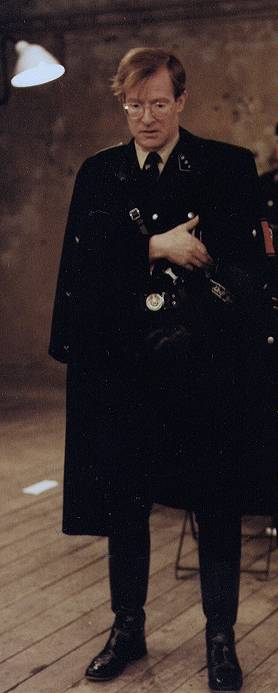
Should theater be offensive? I don't see why not. I don't think that theater should be created with the intention to offend, but that does not neccessarily mean that theater shouldn't be allowed to offend.
My friend brought up a production of CP Taylor's Good, which is a play about a professor who starts off as an intellectual who writes a pro-euthanasia novel and turns into a full fledged Nazi of the 3rd Reich. The play, not surprisingly, sheds light on the psychology of national socialism and clarifies the idea that the Nazi takeover of the german psyche was a gradual process as opposed to an overnight sensation. When she told me about Taylor's play, I got really excited - from my perspective, it's an incredibly interesting question to confront the audience with.
BUT, she would have none of it. The idea that the play would attempt to justify the professor's degradation offended her. At one point in our discussion, she asked if the director really had the right to bring that question to the table - whether it was even ethical to justify a man's transformation into what many would term a monster.
In a conversation at the University of Chicago a couple years ago, Anne Bogart supported the idea that Theater, a giant waste of time, exists to fill the void in America's soul. Since that view of theater makes me feel as though what I'm saying is important, I'm going to run with it.
Bottom line, I really thing it's all fair game. Here's why: Theater, to me, is about story telling. Base. Story Telling. Dramatic Journey. The job of the director is to communicate a story, coherently and cohesively, to the audience. I could fault a director for preaching, but to be fair every textual interpretation will contain the biases of the interpreter, and it's the director's prerogative to let the audience see the story from his or her perspective
I understand how my friend could have gotten offended, and that she may not be too happy about what she saw, but how awesome is the idea that an innocent man can be corrupted by something so heinous? Without acknowledging it, understanding it, exploring it...can't it happen again? The bottom line is this production has stuck with her. Maybe it was the swastikas that they dropped from the catwalk at the end of the play...maybe not...but this production was the first thing she jumped to when I mentioned that i saw a place for provocative subject matter on stage.
Personally, I don't think that you should restrict theater from going anywhere...other than to the realm of bad taste. Nobody should be subjected to those horrors. Fucking Alan Cumming.
Saturday, July 5, 2008
Top Girls, 6/25/08 @ Biltmore Theater in NYC
Manhattan Theater Club Production
Directed by James Macdonold
With: Marisa Tomei, Elizabeth Marvel, and a set of ineffective compatriots
Closed 6/29/08
I went to see Top Girls with my parents. It was unfortunately awful. Granted, I know every word of that play intimately given that I spent about 2 months with the script in rehearsal AND granted, our production was probably one of the best pieces of theater i have been involved in, I think any theatrically objective and educated individual would find the MTC production a let down. Beyond the easy gripes of affected performances and meaningless choices which mitigated the power of Churchill's wonderful writing, there were some structural choices that really really really cannot be forgiven.
No, actually, lets start with discussing the overarching problem: until act 3 they were playing the text for cheap moments. Sensible conversation and communication between the actresses rarely happened until Tomei and Marvel fought at the closing of the play. Often enough, one actress began to connect with some honesty! Unfortunately, her efforts were usually foiled by her scene partner. Moving on.
 My primary concern lied with the choice to reorganize the casting. Churchill's act 1 characters represent allegories to the characters in act 2 and act 3, so arbitrarily reassigning act 1 characters to actresses based on ability meant actors were moving in and out of characters' dramatic arcs. There is no way Pope Joan and Angie have anything in common with respect to Marlene's journey. Likewise, Patient Griselda really has nothing to do with Shona/Kit's psychology.
Anyway, All things together, I'd say it's a good thing this production closed.
On second thought, to be fair, while the stage direction and acting could've been better, i was very impressed with the set and original sound (though i believe the latter was vastly underutilized). Each act would see a bare stage transformed as set pieces flew in/backdrops swept across the stage. Quite impressive...Not $90 impressive, but impressive.
They also used the same ikea chairs we did. WTF.

Directed by James Macdonold
With: Marisa Tomei, Elizabeth Marvel, and a set of ineffective compatriots
Closed 6/29/08
I went to see Top Girls with my parents. It was unfortunately awful. Granted, I know every word of that play intimately given that I spent about 2 months with the script in rehearsal AND granted, our production was probably one of the best pieces of theater i have been involved in, I think any theatrically objective and educated individual would find the MTC production a let down. Beyond the easy gripes of affected performances and meaningless choices which mitigated the power of Churchill's wonderful writing, there were some structural choices that really really really cannot be forgiven.
No, actually, lets start with discussing the overarching problem: until act 3 they were playing the text for cheap moments. Sensible conversation and communication between the actresses rarely happened until Tomei and Marvel fought at the closing of the play. Often enough, one actress began to connect with some honesty! Unfortunately, her efforts were usually foiled by her scene partner. Moving on.
 My primary concern lied with the choice to reorganize the casting. Churchill's act 1 characters represent allegories to the characters in act 2 and act 3, so arbitrarily reassigning act 1 characters to actresses based on ability meant actors were moving in and out of characters' dramatic arcs. There is no way Pope Joan and Angie have anything in common with respect to Marlene's journey. Likewise, Patient Griselda really has nothing to do with Shona/Kit's psychology.
Anyway, All things together, I'd say it's a good thing this production closed.
On second thought, to be fair, while the stage direction and acting could've been better, i was very impressed with the set and original sound (though i believe the latter was vastly underutilized). Each act would see a bare stage transformed as set pieces flew in/backdrops swept across the stage. Quite impressive...Not $90 impressive, but impressive.
They also used the same ikea chairs we did. WTF.
Subscribe to:
Posts (Atom)

 Posts
Posts


